
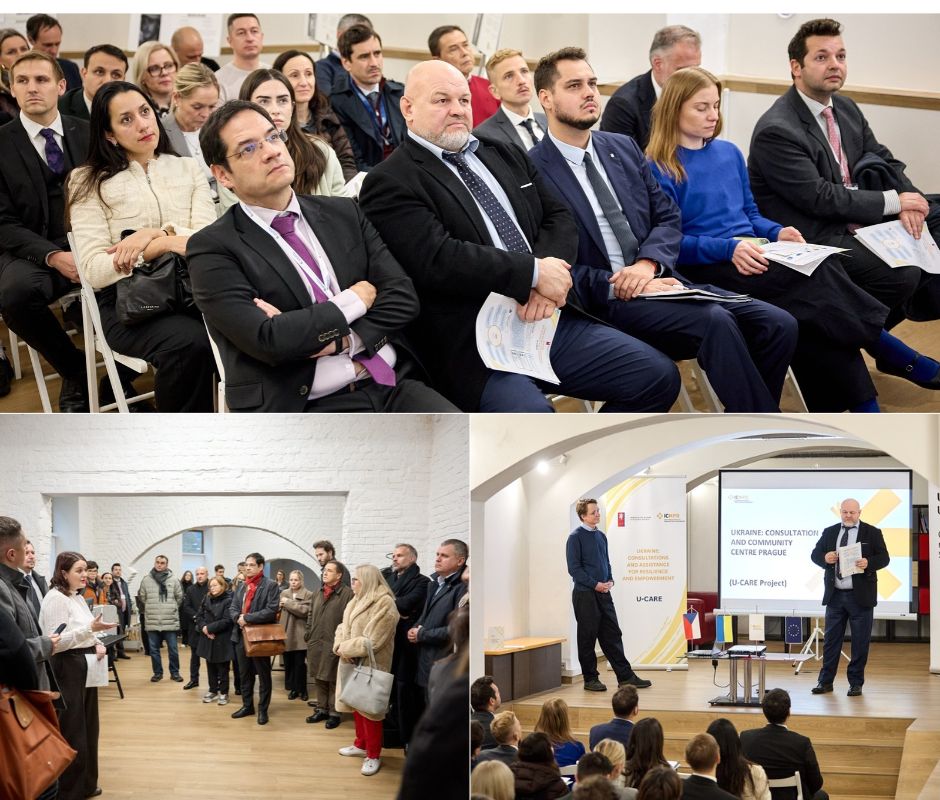
Prague, 11 November 2026
On 11 November 2026, at the margins of the Prague Process Senior Officials’ Meeting, representatives of the migration authorities of several EU Member States, Moldova, the European Commission and international organisations visited the Ukrainian Consultation and Community Centre (UCCC) in Prague, operated by the International Centre for Migration Policy Development (ICMPD).
Following opening remarks by representatives of the Czech Ministry of the Interior, the Embassy of Ukraine and ICMPD, participants learned about the UCCC’s activities, services and community engagement initiatives supporting displaced Ukrainians in the Czech Republic, as well as key results, operational experience and lessons learned. The presentation by the UCCC Coordinator also offered insights into the needs of the Ukrainian community and evidence gathered during the daily consultations. The guided tour also included the current exhibition, Unissued Diplomas.
Established in 2023, the Centre has assisted more than 12,300 beneficiaries, including over 5,300 since the launch of the U-CARE project. With approximately 30 visitors per day and more than 500 per month, it continues to respond to a broad range of practical needs. Its services cover temporary protection and residence matters, passport and consular procedures, notarial services, pension entitlements, banking and property issues, civil status documentation, education and diploma recognition, as well as transport and insurance-related questions.
The Centre's 2026 consultation trends highlight how the needs of displaced Ukrainians are evolving beyond immediate protection and settlement. Pension-related matters and access to the Ukrainian Pension Fund, for instance, accounted for the highest number of recorded consultations, followed by assistance with Ukraine's Diia digital services, banking operations, notarial procedures, temporary protection and passport services. Support with digital tools and electronic signatures is increasingly important, enabling beneficiaries to manage administrative procedures remotely and maintain access to essential services in Ukraine while living abroad.
Beyond individual consultations, the UCCC has meanwhile evolved into a Unity Hub-like Center, which also provides a space for community interaction, knowledge exchange and cultural activities. Its programme includes information sessions, workshops, educational events, film screenings, performances, concerts and exhibitions. Recent sessions have addressed practical topics such as employment and labour rights in the Czech Republic, taxation, diploma recognition, family rights and the International Damage Register. The Centre also works closely with Ukrainian diaspora organisations, supporting networking, joint initiatives and capacity-building through workshops, fundraising activities and exchanges with Ukrainian institutions and community representatives. The Centre’s integrated approach combines individual guidance with opportunities for community participation, addressing both immediate practical needs and long-term social cohesion.
The subsequent exchange focused on key challenges and opportunities related to integration and social cohesion, cooperation between national authorities, international organisations and civil society, as well as possible ways to address the evolving needs of displaced Ukrainians. The visit also provided an opportunity to consider how experience gained through the UCCC’s community-based support model could inform similar initiatives in other European countries hosting displaced Ukrainians.
The visit underlined the importance of linking migration policy discussions with practical experience on the ground. The Centre's experience demonstrates how accessible information, administrative guidance, digital support and community engagement can complement institutional responses to displacement, while empowering displaced communities to navigate everyday challenges and build connections in their host country. It also illustrates the value of cooperation between national authorities, international organisations and Ukrainian civil society in developing responses that reflect the changing needs of displaced communities.