
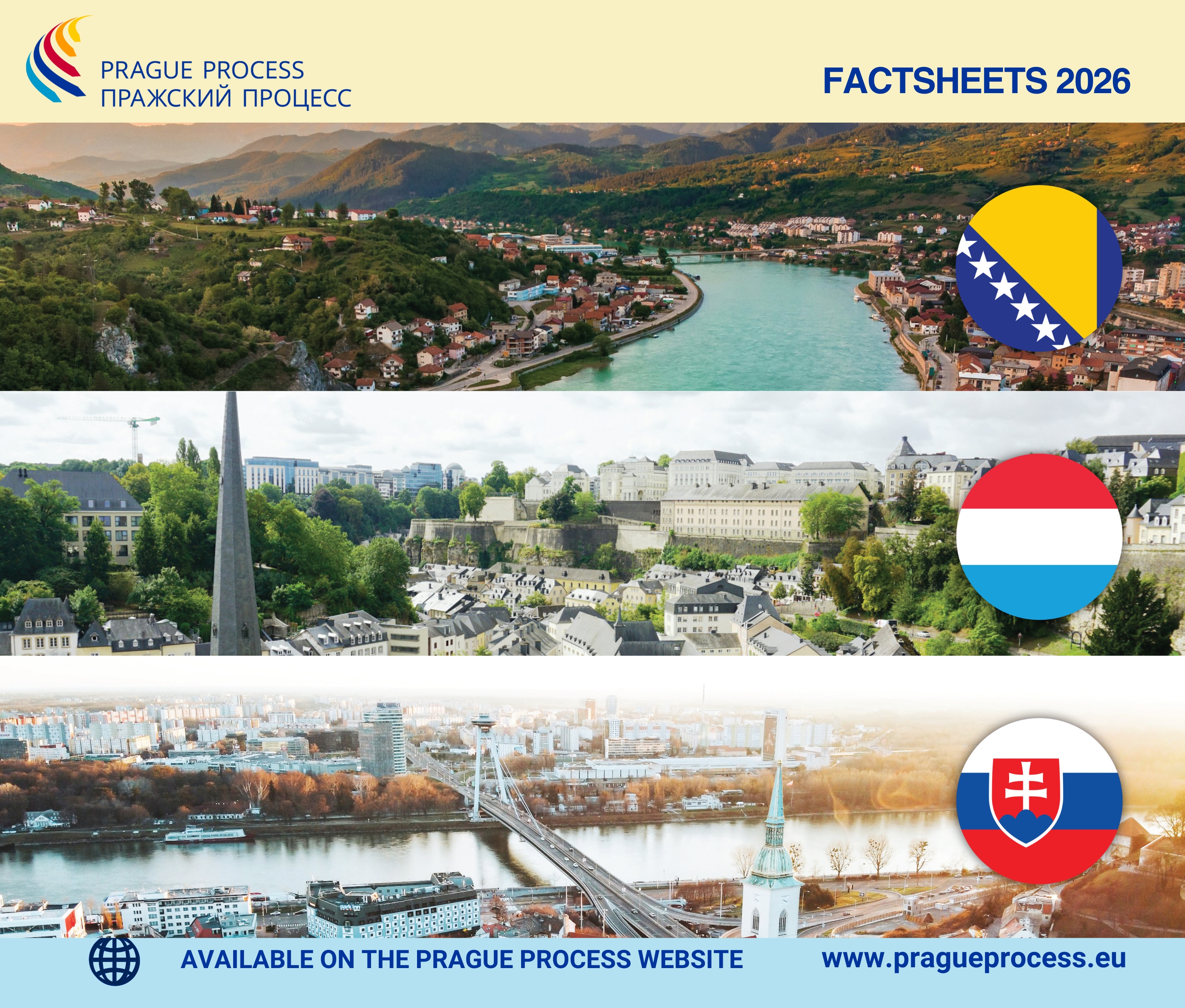
We have the pleasure to inform you that the Prague Process has introduced the regular update of the country factsheets, now featuring the latest migration-related trends and policy developments in Bosnia and Herzegovina, Luxembourg and Slovakia.
Here are a couple of highlights that offer a glimpse into recent developments. Explore the full version of the factsheets to review the detailed analysis and data.
Bosnia and Herzegovina: Diaspora-driven demography
- An estimated 2.2 million people of BiH origin – around 65% of the current population of 3,412,000 – reside abroad, primarily in Europe and North America.
The number of foreign citizens residing in Bosnia and Herzegovina remains low, although labour migration inflows are gradually increasing due to workforce shortages. The 15% rise in work permits, from 5,293 in 2023 to 6,085 in 2024 – mostly issued to citizens of Serbia, Türkiye, China, India and Croatia – suggest a modest increase in labour migration, yet these inflows remain too limited to significantly alter the country’s persistently small foreign-resident base.
Luxembourg: Migration-driven diversity
- The Grand Duchy of Luxembourg, with population of 681,973 people as of January 2025, is one of Europe’s demographically most diverse states. In early 2025, 47% of Luxembourg’s population were foreign nationals, with nearly 180 nationalities represented in the country. According to UN DESA, the country hosted 344,309 international migrants in 2024. The foreign population is predominantly European, with Portuguese (13.1%), French (7.2%), and Belgians (3.8%) forming the three largest communities, together accounting for just over half of all foreigners. Among non-EU nationals, the largest groups come from China (4,961), Brazil (4,300), India (3,224) and Russia (3,211).
- First-time asylum applications in Slovakia fluctuated at relatively low levels between 2015 and 2020 (around 100-265 annually), rose sharply to a peak of about 500 in 2022, before declining again to 370 in 2023 and falling further to around 135 in 2024. Since the start of Russia’s full-scale invasion of Ukraine, over 2.5 million people had crossed into Slovakia by September 2024. As of October 2025, over 137,000 persons who fled Ukraine resided in Slovakia under temporary protection. To support a coordinated response, the Ministry of the Interior and UNHCR adopted a Refugee Response Plan in 2024, strengthening assistance in protection, education, healthcare, and psychosocial support.
All the factsheets can be accessed through the interactive map here.
The factsheets offer concise and valuable insights in the migration landscape of these countries, providing data from both national and international sources. They also highlight key developments in migration policies and legislation. While the national data is updated by the Secretariat and ICMPD colleagues as well as external experts, the data from international sources is refreshed automatically as it becomes available.
Our Repository contains the latest publications of the Migration Observatory and Training Academy of the Prague Process.
Subscribe to the Prague Process mailing list here in order to keep up to date with the latest developments through our Quarterly Review.